
Best picks
Best Gravel for a Parking Lot: 2026 Picks
A gravel lot takes more punishment than a home driveway. Cars turn in place, trucks idle and plows scrape it every winter. The surface stone has to lock under tires and shed water fast. Our pick for that top course is 3/4" Crushed Stone, a clean, angular gray rock. Below is why, which two stones help in the layers beneath and how to size the order.
3/4" Crushed Stone
crushed stone · size 3/4 inch · 2,700 lb/yd³ · sold by the ton

Bottom line: 3/4" Crushed Stone for gravel for a parking lot
Our top pick: 3/4" Crushed Stone
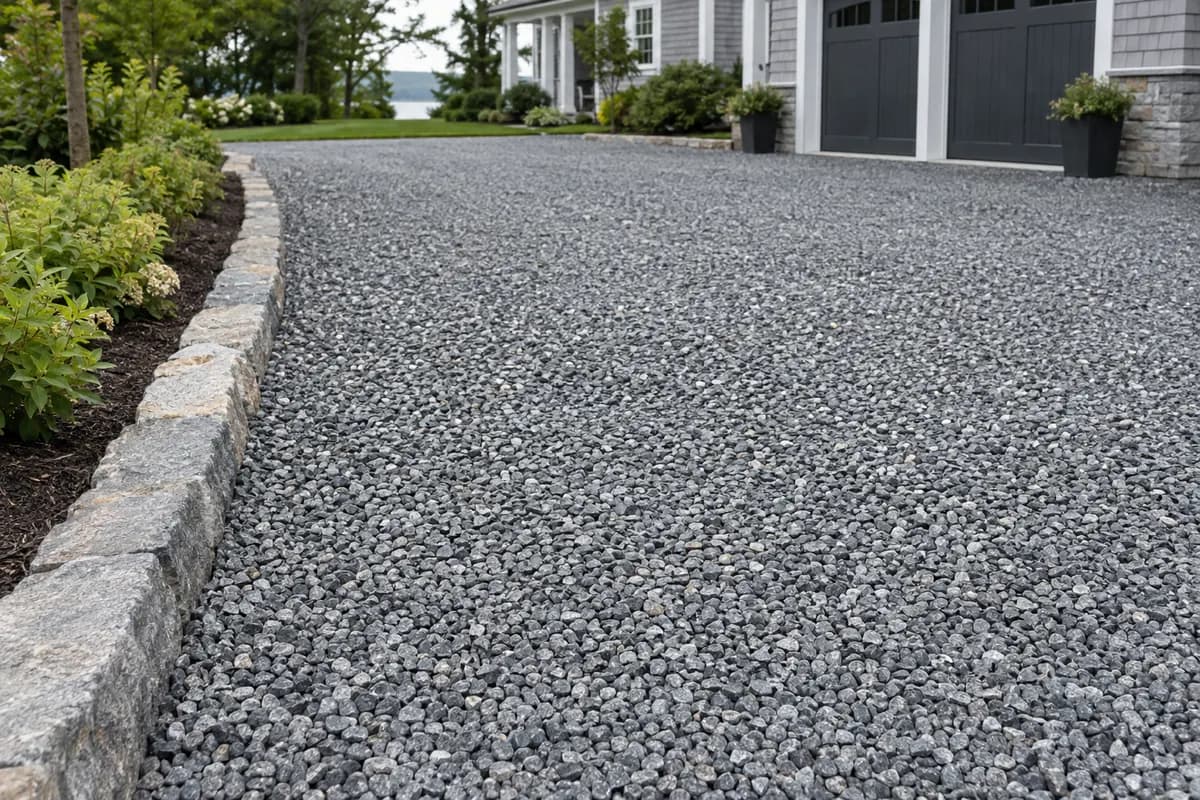
3/4" Crushed Stone is quarry rock broken into angular pieces and screened to a 3/4 inch size. Each piece has flat, fractured faces and sharp corners. Spread across a lot and rolled, those faces bite into one another and form a tight, knitted surface that resists the twisting push of a turning wheel.[1]
The stone is gray and plain, which suits a commercial lot, a church lot, a farm stand or an overflow field. It weighs about 2,700 lb per cubic yard and is sold by the ton. That weight keeps it from flying out from under spinning tires, and the plain color hides oil spots and tire marks better than a pale stone would.[1]
Clean screening matters on a lot. With the dust removed, rain drops between the pieces instead of turning the top into slurry. A lot that drains through its surface stays open for business after a storm, while a muddy lot turns customers away and sends ruts deep into the base.[1]
Crushed stone of this size also takes well to light equipment. A small tractor with a box blade or a rented roller is enough to spread and pack it, so an owner can maintain the lot without calling in a paving crew. That makes the surface easy to keep in shape between full rebuilds.[1]
Why 3/4" Crushed Stone fits a parking lot
Parking lots fail in a few predictable ways. Potholes form where water pools, ruts form along the main drive lane, and loose stone gets pushed into windrows at the edges. The right surface stone slows all three. A 3/4 inch angular rock is small enough to pack into a smooth ride and large enough to stay put when a delivery van swings around a corner.[1]
Smaller stone packs tighter but holds water and wears into dust under constant traffic. Larger stone drains well but rides rough, and pieces kick loose under braking. The 3/4 inch size sits in the middle of that range, which is why it shows up on so many lots and lanes. It handles cars, pickups and the occasional box truck without breaking apart.[1]
A lot surface is only as good as the structure under it. Strip the topsoil, grade the subgrade so it sheds water, then lay a coarse lower layer and a compacted middle layer before the surface course. On soft ground, a woven geotextile on the subgrade keeps the stone from sinking into the mud. The 3/4" Crushed Stone goes on last as the wearing course.[1]
Grading keeps the lot alive. Crown the drive lanes or tilt the whole lot slightly toward a ditch or swale so water leaves the surface quickly. Each spring, run a box blade or a drag across the lot to pull stone back from the edges and fill low spots before they turn into potholes. The gray surface then stays smooth with little more than that yearly pass.[1]
Edges take the most abuse on a gravel lot. Cars that park nose-in push stone forward with every arrival, and plows shove it off the sides each winter. A border of timber, concrete curb or heavy stone along the edges holds the 3/4" Crushed Stone in place and keeps the lot from creeping into the lawn or the ditch. Wheel stops at the head of each space also stop drivers from rolling past the gravel.[1]
Worth considering
#4 Crushed Stone belongs at the bottom of a lot on soft or wet ground. Its pieces are much larger than the surface stone, so it bridges over mud and gives the upper layers a solid footing. Contractors call this the stabilizing course. Spread it over fabric, roll it in, then build the finer layers on top.[1]
#57 Crushed Stone is a clean, mid-size stone that some owners use as the surface on lots with lighter traffic, such as a seasonal overflow area. It drains fast and resists mud. On a busy lot it can feel looser than the smaller surface stone and may need more frequent grading where cars turn, so it wins where traffic is light and drainage is the main concern.[1]
On a full build, the three stones work together. #4 Crushed Stone forms the base on poor soil, a compacted middle layer evens it out, and 3/4" Crushed Stone finishes the top. Each layer does a different job, and together they carry heavy traffic for years.[1]
 From$4242 ton delivered
#57 Crushed Stone
Gravel and Crushed Stone- Size
- 3/4 to 1 inch
- Weight
- 2,700 lb/yd³
- Color
- Gray
 From$4372 ton delivered
#67 Stone
Gravel and Crushed Stone- Size
- 3/4 inch and under
- Weight
- 2,700 lb/yd³
- Color
- Gray
 From$4252 ton delivered
#89 Crushed Stone
Gravel and Crushed Stone- Size
- 3/8 inch
- Weight
- 2,700 lb/yd³
- Color
- Gray
How much to order
Measure the full lot area, including drive aisles, parking rows and any turnaround, and multiply length by width for square feet. Large lots run to thousands of square feet, so split them into rectangles, measure each and add them up. The area calculator can do the conversion to tons.[1]
For the surface course over a sound base, 3 inches of 3/4" Crushed Stone takes about 1.25 tons per 100 square feet. A lighter top dressing on an existing lot, at 2 inches, takes about 0.83 tons per 100 square feet. Most lots stay in that range for the wearing layer.[1]
Where the lot is new and the surface stone also has to carry structure, plan on more. A 4 inch layer of 3/4" Crushed Stone needs about 1.67 tons per 100 square feet, and a 6 inch layer needs about 2.50 tons. Place deep stone in two lifts and roll each one, so the lower half packs as well as the upper half.[1]
Count each layer as its own line on the order. The coarse bottom course, the middle layer and the surface stone arrive on different loads and go down in sequence. Leave space on site for trucks to dump close to where each layer starts, so your loader or skid steer is not hauling stone across the whole lot.[1]
Dust is rarely a problem on a lot topped with clean stone, but it can show up where traffic grinds the surface over time. A light top dressing of fresh 3/4" Crushed Stone every few years restores a clean surface and replaces the stone lost to tires and plows.[1]
| Project size | 3 inch depth | 4 inch depth |
|---|---|---|
| 100 sq ft | 0.9 cu yd / 1.3 tons | 1.2 cu yd / 1.7 tons |
| 300 sq ft | 2.8 cu yd / 3.8 tons | 3.7 cu yd / 5.0 tons |
| 600 sq ft | 5.6 cu yd / 7.5 tons | 7.4 cu yd / 10.0 tons |
Top picks side by side
| Material | Spec | Fit and price |
|---|---|---|
| 3/4" Crushed StoneTop pick | 3/4 inch, gray, 2,700 lb/yd³, by the ton | from $427 delivered, 2 tons |
| #57 Crushed Stone | 3/4 to 1 inch, gray, 2,700 lb/yd³, by the ton | from $424 delivered, 2 tons |
| #67 Stone | 3/4 inch and under, gray, 2,700 lb/yd³, by the ton | from $437 delivered, 2 tons |
| #89 Crushed Stone | 3/8 inch, gray, 2,700 lb/yd³, by the ton | from $425 delivered, 2 tons |
Verdict
3/4" Crushed Stone is the best gravel for the surface of a parking lot. The angular gray pieces lock under turning tires, drain rain straight through and hold up to cars, pickups and delivery vans. Set it over a properly graded and layered base, and drag it each spring to keep the lanes smooth.[1]
Add #4 Crushed Stone at the bottom of any lot built on soft or wet ground. Consider #57 Crushed Stone as a surface only for light, occasional traffic where fast drainage matters most. For a lot that sees steady daily use, the 3/4 inch stone on top is the choice we stand behind.[1]
Get a delivered quote for 3/4" Crushed Stone
Tell us your project and we price 3/4" Crushed Stone delivered to your ZIP, no obligation.
Frequently Asked Questions
What size gravel is best for a parking lot surface?
Clean, angular stone around 3/4 inch works best for the top layer. It packs into a smooth surface, grips tires and drains quickly. 3/4" Crushed Stone is screened to that size, and it holds up to steady car and light truck traffic.
How thick should gravel be in a parking lot?
A full lot has several layers. The surface course of 3/4" Crushed Stone runs about 3 inches over a compacted base, which takes about 1.25 tons per 100 square feet. Soft ground needs a thicker, coarser layer at the bottom.
Do I need fabric under a gravel parking lot?
On clay or wet soil, yes. A woven geotextile laid on the graded subgrade stops the stone from pushing down into the soil and keeps the layers apart. On firm, sandy ground some builders skip it, but it rarely hurts.
What goes under the top layer of a gravel lot?
Large stone such as #4 Crushed Stone forms the bottom layer on poor soil, followed by a compacted middle layer. The surface course of 3/4" Crushed Stone goes on top. Each layer is rolled before the next one is spread.
How do I stop potholes in a gravel parking lot?
Keep water moving off the surface. Grade the lot with a crown or a slight tilt toward a ditch, and drag it each spring to fill low spots before they grow. Clean, angular surface stone drains faster and resists potholes better than dusty mixes.
Is crushed stone better than pea gravel for parking?
Much better. Pea gravel is round, so it rolls and scatters under tires, and cars sink into it. Angular crushed stone locks together into a firm surface. For any area where vehicles park or turn, choose crushed stone.